
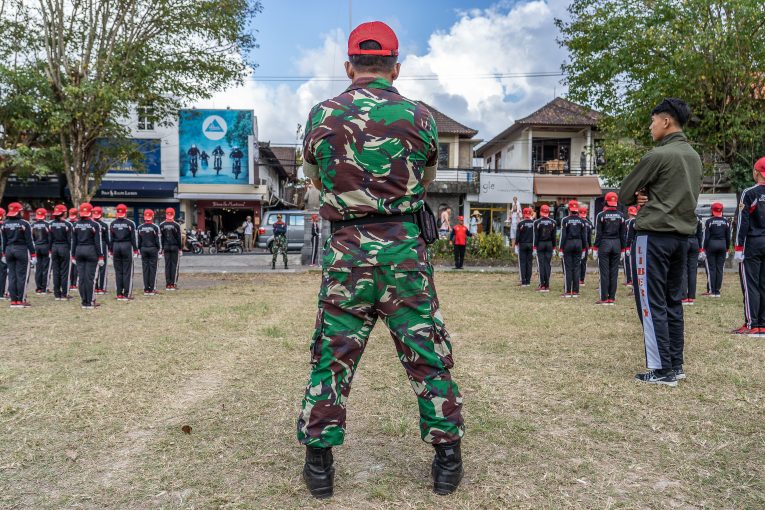
In early 2025, Indonesian authorities introduced a controversial approach to juvenile delinquency by placing so-called ‘troublesome’ youth into military boot camps for six months of intensive discipline and character education (The Jakarta Post, 2025a, 2025b). Spearheaded by West Java Governor Dedi Mulyadi and supported by the Indonesian National Armed Forces (TNI), the programme targets adolescents engaged in school absenteeism, physical altercations, or other risky behaviours (The Jakarta Post, 2025a, 2025b). Children are removed from their homes and schooling and placed into military barracks designed to enforce obedience and personal responsibility through a regimented routine (The Jakarta Post, 2025a, 2025b). By mid-2025, more than 270 students had been enrolled, and the programme’s scope was, at the time, planned to include adults deemed socially disruptive (France-Presse, 2025; Tempo, 2025).
What was once described as a local initiative has since entrenched itself as a recurring feature of West Java’s governance of youth. As of May 2026, Dedi Mulyadi continues to promote the programme and has even extended it with 250 participants scheduled for the June 2026 intake. More strikingly, Mulyadi has publicly proposed sending youth involved in the May Day civil unrest in Dago to the same military barracks, framing detention in military facilities as an appropriate response to political participation by minors (Mardiansyah, 2026). The programme is thus no longer merely a response to juvenile delinquency, but also becoming a general instrument of social control. This trajectory makes the original question surrounding this issue more urgent than ever: does placing children in military-style boot camps offer a constructive and sustainable solution?
Military-style discipline programmes such as boot camps, re-education facilities, and similar interventions have been used around the world as ‘tough love’ solutions for youth considered defiant or delinquent (Gaffney et al., 2021). These programmes typically involve strict regimentation, physical drills, and a heavily controlled environment intended to mimic military training (Gaffney et al., 2021). The theory is that intense discipline can break bad habits and foster respect for authority (Meade & Steiner, 2010). Some also cite behavioural principles, where punishments are rewards are used to shape conduct, and where structure is believed to cultivate character (Gaffney et al., 2021; Meade & Steiner, 2010).
However, decades of research suggest that these assumptions are misplaced. Evidence consistently shows no significant long-term reduction in reoffending among boot camp participants compared to youth in traditional juvenile detention – and in some cases, boot camp graduates were slightly more likely to reoffend, suggesting the programmes may be counterproductive (MacKenzie et al., 2001). Similarly, deterrence-based programmes have been found to increase the likelihood of reoffending with participants faring worse than those who received no intervention at all (Petrosino et al., 2013).
Some boot camps do report temporary improvements in youth attitudes and compliance, but these gains are typically limited to the highly structured, surveillance-heavy environment of the camp itself (Mackenzie et al., 2001). Once participants leave, the absence of continuous structure and support often leads to a regression into prior behaviours (MacKenzie et al., 2001). Youth in boot camps have described their environments as more structured and active than traditional detention facilities, and some reported feeling safer during their stay (Bottcher & Ezell, 2005). Yet, these short-term perceptions do not translate into meaningful long-term outcomes, such as reduced criminality or improved psychosocial functioning (Gaffney et al., 2021; MacKenzie et al., 2001).
The Indonesian programme as it operates raises precisely these concerns. Officials in Purwakarta have pointed to three-day observations of improved waking routines and prayer attendance as evidence of the programme’s success (BBC News Indonesia, 2025). These accounts are not implausible – behavioural compliance within a highly controlled environment is a well-documented short-term effect. What research consistently shows, however, is that such compliance rarely persists once external controls are removed (MacKenzie, 2001).
This is because the improvements in compliance seen during boot camp stays are generally extrinsically motivated – driven by the threat of punishment and the presence of authority figures (Meade & Steiner, 2010). Once these external controls are removed, the behaviour often reverts. The issue, therefore, is not whether behaviour can be controlled in a highly structured environment, but whether that behaviour can sustain itself and endure once the structure is gone. This is where the question of sustainability becomes central. Behaviour maintained through external controls is, by definition, externally regulated – and when adolescents return to their everyday environments, where those controls no longer exist, the behaviour tends to disappear with them.
This matters because juvenile delinquency itself is not a short-term behavioural deviation that can be corrected in isolation. It is shaped by a complex interaction of individual, family, school, and community factors (Ryon et al., 2017). Research consistently shows that effective interventions must therefore be ecological and multi-systemic, addressing the environments in which young people actually live. Mulyadi’s military programme, however, does the opposite. Rather than working within these systems, they temporarily remove adolescents from them – interrupting, rather than strengthening, the very relationships and systems that research identifies as central to lasting change.
To be clear, the problem with the boot camp model is not the removal itself — it is what does not happen during and after it. The barracks is treated as the destination rather than a bridge to something better. When the programme ends, the young person is returned to the same family dynamics, the same school environment, the same peer pressures, and the same underlying stressors that shaped their behaviour in the first place. Nothing in that world has changed. The removal was the entire plan.
This is the fundamental structural flaw: the boot camp model attempts to change the child without changing the context the child lives in. School attachment is one of the most consistently identified protective factors against delinquency (Kearney & Graczyk, 2020), yet the programme severs it. Parental monitoring and positive parent-child bonds are among the strongest buffers against adolescent offending (Lee et al., 2012), yet no work is done with families. Whatever brief improvements occur inside the barracks are achieved in a context entirely disconnected from the dynamics that will govern the young person’s behaviour once they return home. The home has not changed. No relationships have been repaired. The child returns to the same environment that contributed to the problem — and that environment is waiting, untouched.
Research is consistent on what actually works. Programmes that produce lasting outcomes operate within the ecological systems surrounding the young person – family, school, peers, and community – rather than removing the individual and attempting correction in isolation (Ryon et al., 2017; Welsh & Farrington, 2007). Family-focused interventions that improve communication, supervision, and emotional connection consistently show meaningful reductions in reoffending – not by removing children from their homes, but by improving the homes they return to (Ryon et al., 2017). School-based interventions succeed not by relocating young people, but by addressing the school environment, the teacher relationship, and the family-school connection in an integrated and sustained way (Kearney & Graczyk, 2020; Milne et al., 2003). Across community-based programmes, longitudinal studies, and juvenile justice evaluations, the evidence converges on the same point: lasting reductions in problematic behaviour require interventions that are multimodal, individualised, and relational — not brief, uniform, and isolating (Milne et al., 2003; Mann & Reynolds, 2006; Ryon et al., 2017).
What Mulyadi’s programme offers, then, is the appearance of intervention without its substance. It relocates the young person, imposes temporary compliance, and returns them – unchanged in any durable sense – to environments that have not been touched. The parents have received no support. The school has not been made more engaging. The underlying stressors – economic, familial, and psychological – have not been addressed. Lasting change cannot be drilled into a teenager. It emerges through sustained relationships, meaningful engagement with school and community, and the gradual development of intrinsic motivation, self-efficacy, and pro-social identity – all of which require supportive environments to take root. None of that can happen in a barracks. And none of it will happen outside one unless someone has done the work to prepare for it.
The question is not simply whether boot camps work in the short term. It is whether removing a young person from their environment — without doing anything to change that environment — can ever produce results that last. Research says no. The removal, without transformation, changes nothing. It simply delays the return to a world that has been left exactly as it was.
Akmal Naseery, Center for Public Mental Health
References
BBC News Indonesia. (2025, May 6). Dedi Mulyadi kirim pelajar ‘bandel’ ke barak militer – Apa akibatnya? BBC News Indonesia. https://www.bbc.com/indonesia/articles/c7932qp4n2ro
Bottcher, J., & Ezell, M. E. (2005). Examining the Effectiveness of Boot Camps: A Randomized Experiment with a Long-Term Follow Up. Journal of Research in Crime and Delinquency, 42(3), 309–332. https://doi.org/10.1177/0022427804271918
France-Presse, A. (2025, May 9). Indonesia could expand program sending troublesome students to military barracks – minister. The Manila Times. https://www.manilatimes.net/2025/05/09/world/asia-oceania/indonesia-could-expand-program-sending-troublesome-students-to-military-barracks-minister/2109985
Gaffney, H., Farrington, D. P., & White, H. (2021). Boot Camps (Youth Endowment Fund Toolkit Technical Report) [Toolkit Techincal Report]. Youth Endowment Fund.
Kearney, C. A., & Graczyk, P. A. (2020). A Multidimensional, Multi-tiered System of Supports Model to Promote School Attendance and Address School Absenteeism. Clinical Child and Family Psychology Review, 23(3), 316–337. https://doi.org/10.1007/s10567-020-00317-1
Lee, J., Onifade, E., Teasley, M., & Noel, L. (2012). The Effects of Risk and Protective Factors on Juvenile Delinquency in South Korea. Journal of Ethnicity in Criminal Justice, 10(4), 316–329. https://doi.org/10.1080/15377938.2012.732880
MacKenzie, D., Gover, A., Armstrong, G., & Mitchell, O. (2001). A National Study Comparing the Environments of Boot Camps With Traditional Facilities for Juvenile Offenders.
Mackenzie, D. L., Wilson, D. B., & Kider, S. B. (2001). Effects of Correctional Boot Camps on Offending. The ANNALS of the American Academy of Political and Social Science, 578(1), 126–143. https://doi.org/10.1177/000271620157800108
Mann, E. A., & Reynolds, A. J. (2006). Early Intervention and Juvenile Delinquency Prevention: Evidence from the Chicago Longitudinal Study. Social Work Research, 30(3), 153–167. https://doi.org/10.1093/swr/30.3.153
Mardiansyah, W. (2026, May 3). Gubernur Jabar Dedi Mulyadi Tawarkan Program Barak Militer untuk Pelaku Kerusuhan saat May Day. Metro TV. Metro TV. https://www.metrotvnews.com/read/NOlC95pn-gubernur-jabar-dedi-mulyadi-tawarkan-program-barak-militer-untuk-pelaku-kerusuhan-saat-may-day
Meade, B., & Steiner, B. (2010). The total effects of boot camps that house juveniles: A systematic review of the evidence. Journal of Criminal Justice, 38(5), 841–853. https://doi.org/10.1016/j.jcrimjus.2010.06.007
Milne, B., Chalmers, S., Waldie, K., Darling, H., & Poulton, R. (2002). Effectiveness of a community-based truancy intervention: A pilot study. New Zealand Journal of Educational Studies, 37, 191–203.
Petrosino, A., Turpin-Petrosino, C., Hollis-Peel, M. E., & Lavenberg, J. G. (2013). ‘Scared Straight’ and other juvenile awareness programs for preventing juvenile delinquency. Cochrane Database of Systematic Reviews, 2013(4). https://doi.org/10.1002/14651858.CD002796.pub2
Ryon, S. B., Winokur Early, K., & Kosloski, A. E. (2017). Community-based and family-focused alternatives to incarceration: A quasi-experimental evaluation of interventions for delinquent youth. Journal of Criminal Justice, 51, 59–66. https://doi.org/10.1016/j.jcrimjus.2017.06.002
Supriyadi, A., & Setiyawati, D. (2020). Validation of training module to increase self-efficacy of adolescent peer counsellors in Indonesia. Journal of Mental Health, 29(4), 385–391. https://doi.org/10.1080/09638237.2019.1608926
Tempo. (2025, May 8). Governor dedi mulyadi has sent 272 high schoolers to military barracks since may 1. Tempo. https://en.tempo.co/read/2005082/governor-dedi-mulyadi-has-sent-272-high-schoolers-to-military-barracks-since-may-1
The Jakarta Post. (2025a, April 29). West Java to send ‘delinquent’ students to military camps—Archipelago. The Jakarta Post. https://www.thejakartapost.com/indonesia/2025/04/29/west-java-to-send-delinquent-students-to-military-camps.html
The Jakarta Post. (2025b, May 15). West Java to also send ‘unruly’ adults to military barracks—Archipelago. The Jakarta Post. https://www.thejakartapost.com/indonesia/2025/05/15/west-java-to-also-send-unruly-adults-to-military-barracks.html
Welsh, B. C., & Farrington, D. P. (2007). Scientific Support for Early Prevention of Delinquency and Later Offending. Victims & Offenders, 2(2), 125–140. https://doi.org/10.1080/15564880701263114